From Handling Customers to Understanding Them
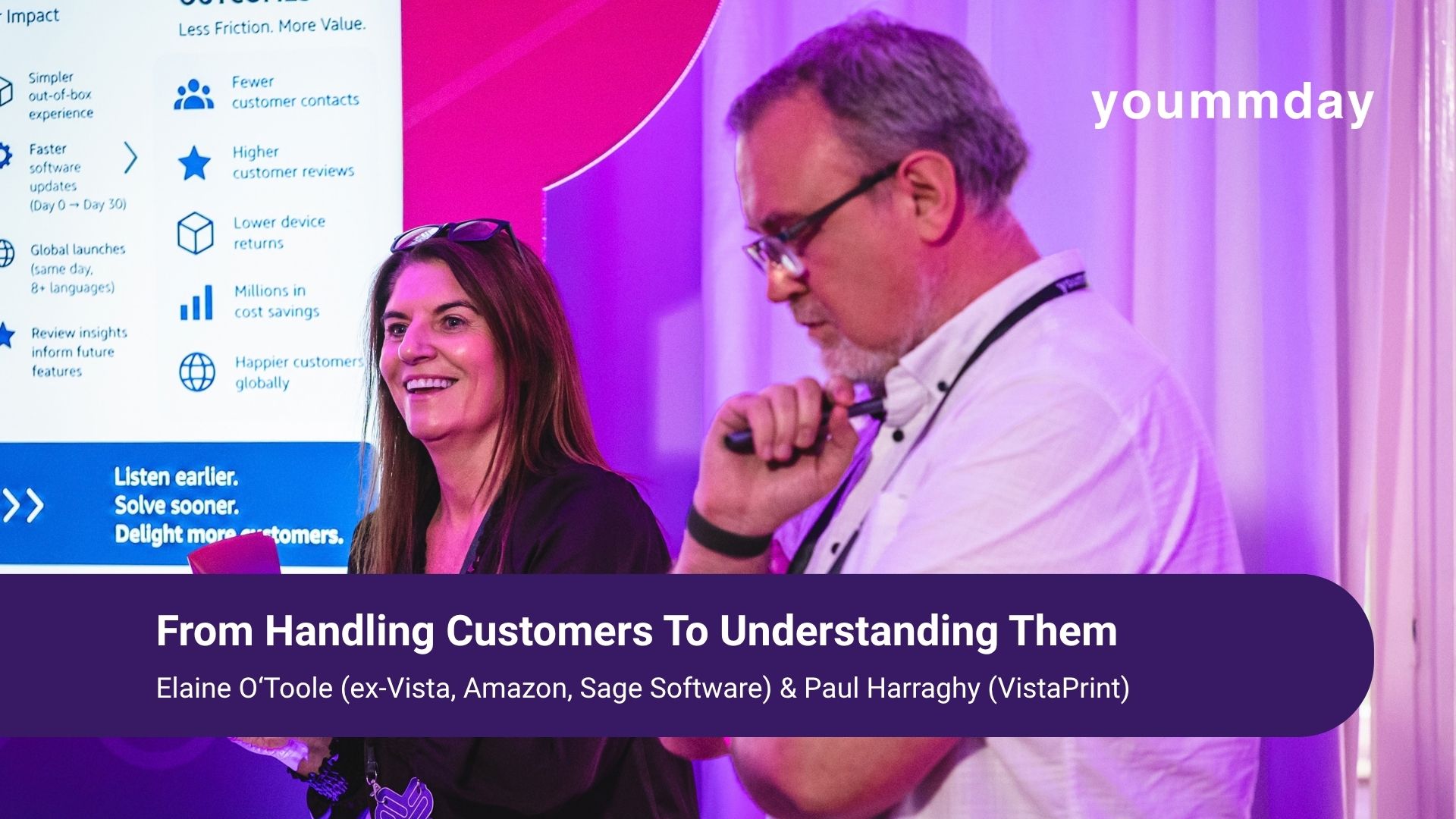
An insight piece based on a presentation by Elaine O’Toole (ex-Amazon, Sage Software, Vista) and Paul Harraghy (Vistaprint)
Why this matters for customer service today
Most organizations treat customer service as the last line of defense. Something goes wrong, a customer calls, the problem gets handled. Cost managed. Case closed.
At yoummday, we believe that frame is not just limiting – it is leaving significant value on the table. Every customer interaction contains signals: what is frustrating to customers, what is driving them away, what they would buy if someone asked. The organizations pulling ahead are not the ones handling that signal most efficiently. They are the ones listening to it most carefully – and feeding what they hear back into the business.
That argument was brought to life at our CX event younite 2026 by Elaine O’Toole and Paul Harraghy, two leaders who have spent their careers building exactly that kind of organization – first at Amazon, then at Vistaprint. Their talk, “From Handling Customers to Understanding Them”, was not a theory. It was a playbook, built from two decades of practice.
The question underneath the question
Elaine opened with a story from 2007. When she joined Amazon, almost 50% of all customer service contacts across millions of interactions were related to one thing: customers calling to ask where their parcel was.
The reactive response would have been to handle those contacts faster, cheaper, and at scale. That is what most organizations would have done.
Amazon asked a different question: why do customers need to call at all?
That question – not “how do we handle this better?” but “why does this problem exist?” – became the foundation of everything Elaine and Paul built at Amazon and later at Vistaprint. It is the difference between a customer service organization that manages problems and one that eliminates them.
The answer, in Amazon’s case, took years and involved more than thirty teams. Tracking technology improved. Proactive notifications were introduced. Customers went from hoping their parcel would arrive to watching their delivery truck approach on a map. Contacts related to delivery dropped from nearly half of all volume to a fraction of that, not because Amazon got better at answering the question, but because it got better at making the question unnecessary.
What customers tell you, if you listen
The delivery story is one example of a much broader principle. Every time a customer contacts you, they are telling you something about your product, your process or your experience. Most organizations treat that signal as a problem to close. The ones that win treat it as intelligence to act on.
At Amazon, this became a structural commitment. When the Kindle launched and contact volumes spiked as non-technical customers struggled with the device, Elaine’s team did not just hold up capacity to handle the calls. They analyzed every contact, identified every friction point, and fed that intelligence directly to the engineering and product teams. The result was a continuous loop: customer contacts surfaced the problems, the product teams fixed them, and the next generation of the device was better because of it.
“We were able to push all the insight very quickly to the engineering and product and UX teams,” Elaine explained. “So, we created a full loop mechanism, a very fast full loop mechanism.”
Paul joined Amazon in 2011 to lead the continuous improvement function for Kindle. His team’s job was not to handle contacts – it was to eliminate the reasons customers needed to contact in the first place. “We looked at all the reasons customers were contacting,” he said, “and figured out how we could make it better. Reduce the contacts. That helps with costs, but it’s also friction in the customer experience.”
To do this at scale, they invested in analytics tools that allowed them to process customer feedback in near real time – identifying the keywords driving complaints, surfacing the patterns, and getting insights to product teams within hours rather than weeks. What had once taken manual analysis over days could now be done in minutes.
From Amazon to Vistaprint: rebuilding from scratch
When Elaine joined Vistaprint, brought in by the CEO to reinvent the customer service organization, she found a business that had the ambition but not yet the infrastructure.
There was a voice-of-the-customer team. But it did not yet have a real voice-of-the-customer program. “They were limited to solving things customer service could solve,” Paul explained, “rather than really influencing product and other parts of the organization.”
The first task was to build the infrastructure to listen – systematically, at scale, and in a way that could actually change things upstream.
They built what they called Listening Labs. Every month, colleagues from across the business – engineers, product leaders, designers, regional teams – join sessions where they listen to real customer calls. Not focus groups. Not surveys. Actual customer conversations, in real time.
In the first quarter of the program, a hundred people attended. Within a year, that number had grown to more than 900 per quarter.
“When people actually listen to a call and hear what the customer is experiencing,” Paul said, “it makes engineers think differently about how they build. It makes designers think differently about how they design the front end. The power of actually doing that is real.”
The format matters. Data can tell you what is happening. Listening tells you why, and more importantly, it makes the problem feel real to the people who have the power to fix it.
Turning insight into product improvement
The Listening Labs are not an end to themselves. They feed into a structured program that connects customer insight into product decisions, commercial outcomes and executive accountability.
Paul’s team provides regular readouts to product teams, category teams and regional leaders: what are the main pain points driving contacts? What is costing the business in the contact center – and what is that costing customers in friction and revenue?
One example: an add-to-cart error that prevented customers from reordering a design they had ordered previously. The team identified it as a significant driver of contact center cost. But the bigger impact was not the cost – it was the number of customers who simply abandoned rather than calling. The fix was not just about reducing contacts. It was about recovering conversion that was being lost silently, across the site.
In the last year alone, 94 product enhancements have been driven directly by customer insight from the care team – generating €2.6 million in contact center savings, and significantly more in revenue impact and friction reduction for customers.
“It wasn’t just about fixing the error,” Elaine said. “It was about all the other value upstream it would actually add.”
The value that hides in plain sight
One of the most striking findings from Vistaprint’s work is what happens to revenue when customer service gets it right.
Customers who speak with a Vistaprint care specialist have a 70% higher lifetime value over the following twelve months than customers who do not. Some of that is correlation – higher-value customers are more likely to reach out. But even after normalizing for that, the team can demonstrate a clear causal link: the interaction itself creates value.
This led to something that might seem counterintuitive. Rather than reducing outbound contact, Vistaprint extended it. For high-value customers – particularly those with abandoned carts or recent deliveries – the team now makes proactive outreach calls. Not to sell. To check whether there is friction, ask about the customer’s business, and create a moment of genuine connection.
The results are measurable. Customers who receive these outbound interactions show a 12% uplift in lifetime value over the following twelve months.
Paul shared an example that captures the spirit of it. A customer in Colorado ran two game stores. A specialist called to check whether there was any friction with a recent order. There was not – the customer was just waiting for a sale. The specialist matched the sale price. Then asked about the business. Discovered the customer had just opened a coffee shop inside one of the stores. Asked if they had ever considered Vistaprint for branded coffee cups. They had not. The specialist designed a sample and sent it out. The following week, the customer ordered a thousand cups.
“That is the shift from transactional to relational,” Elaine said. “From handling customers to understanding them.”
How to measure what customer service is actually worth
The commercial model at Vistaprint reflects this shift.
Paul’s top metric on his quarterly business review is not cost per contact or handle time. It is the percentage of Vistaprint revenue that the care team contributes – the variable gross profit generated by customer service interactions.
Specialists are not incentivized to convert customers. Their scorecards measure quality: were they curious? Did they ask about the customer’s business? Were they proactive about options? But through regression analysis, the team has shown that specialists who score highly on these quality dimensions also produce better customer outcomes – higher facilitation rates, stronger lifetime value.
“We have a thing called facilitation rate rather than conversion rate,” Paul explained. “It’s a little bit less salesy. Did we facilitate you, rather than did we get you to convert?”
Three key takeaways for CX decision-makers
1. Change the question
The organizations winning in customer experience are not asking, “how do we handle this better?” They are asking, “why does this problem exist?” The difference is fundamental. One optimizes the cost of a broken experience. The other eliminates the cost by fixing the experience. Every contact your customers make is a signal about something that could be better. Are you listening to it, and does it reach the people who can act on it?
2. Build the infrastructure to close the loop
Insight without infrastructure is noise. Vistaprint’s Listening Labs work because they are systematic, recurring, and connected to decision-making; not because someone occasionally shares a customer story in a meeting. Engineers listen. Product leaders listen. Executives review the pain points quarterly. Build the mechanism that gets customer insight to the people who can change what customers experience and hold those people accountable for acting on it.
3. Measure the value, not just the cost
If the top metric for your customer service function is cost per contact, you are measuring the wrong thing. The question is not how cheaply you can handle a contact; it’s what value that contact creates. A customer who speaks to a specialist has a 70% higher lifetime value over the next twelve months. That is a business case. Build the analytics to see it, and you change the conversation with your CFO entirely.
About the speakers
Elaine O’Toole is a global CX leader with over 20 years of experience across product, operations and customer experience, including senior roles at Amazon and Vistaprint. She is a member of the Advisory Board at yoummday.
Paul Harraghy leads customer care, relationships and engagement at Vistaprint, where he has spent five years building one of the most data-driven and commercially oriented customer service organizations in the industry. He is passionate about continuous improvement and using the voice of the customer to directly shape product and business decisions.
This article draws on a presentation by Elaine O’Toole and Paul Harraghy at younite 2026, yoummday’s event for CX leaders, held under the theme “ThisGen CX: From Cost to Value.”