The BPO Model is Broken: The Abstraction of Value in Customer Operations
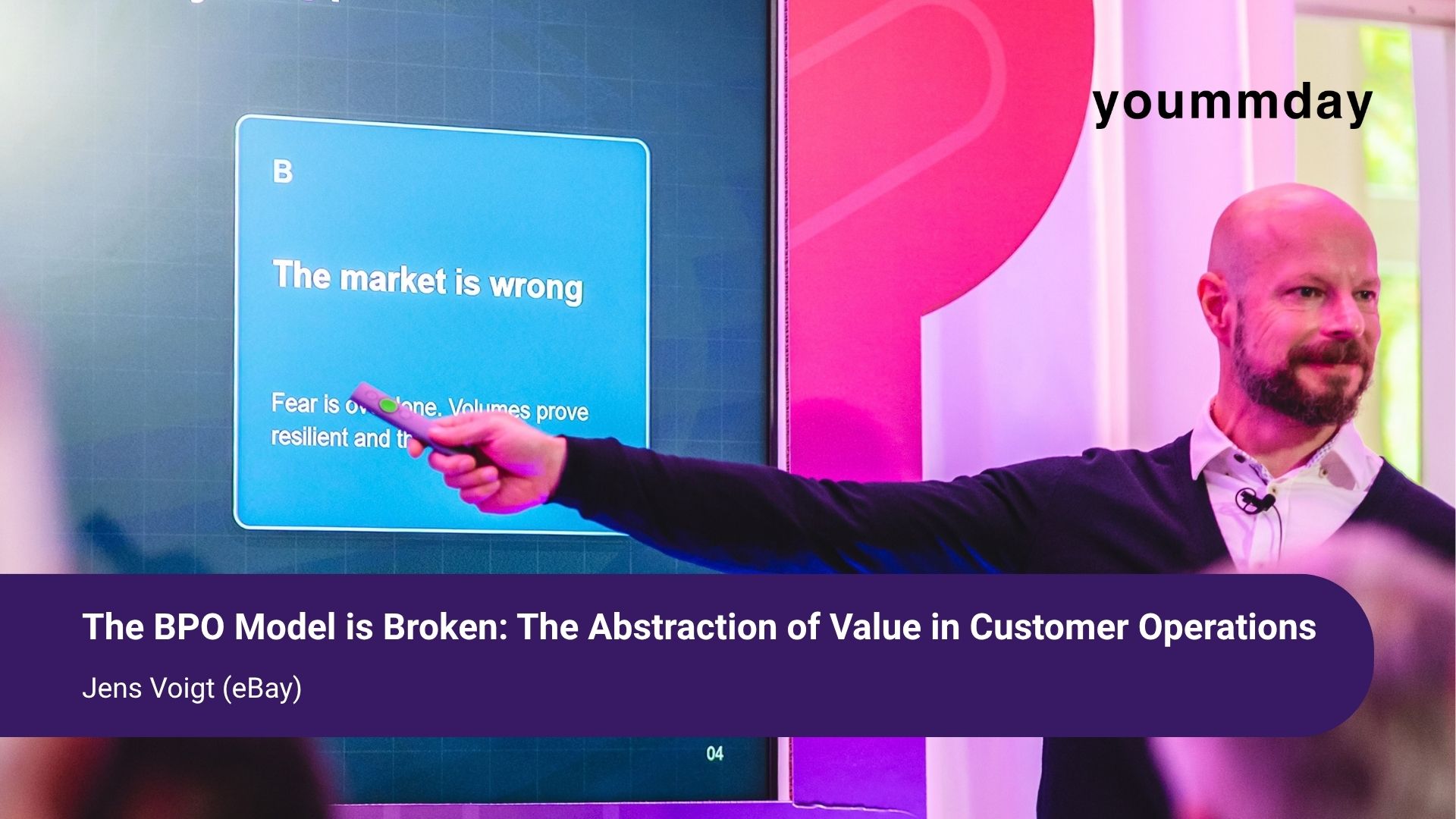
An insight piece based on a presentation by Jens Voigt, Director Strategic Partnerships, eBay
Why this matters for customer service today
Customer service has long been treated as a cost to manage rather than a value to grow. The industry that delivers it – BPO, or business process outsourcing – has been built around the same logic for three decades: the more people you have, the more money you make. Price by headcount. Measure by cost per contact. Optimise for efficiency.
At yoummday, we believe this model is fundamentally misaligned with what customer service can actually deliver – and what clients genuinely need. The question is not how to do CX more cheaply. It is how to build a model where every customer interaction has a measurable return.
That argument was made with refreshing precision at our CX event younite 2026 by Jens Voigt, Director Strategic Partnerships at eBay. His talk, “The BPO Model is Broken”, did not just diagnose the problem. It mapped a path out of it.
The market has already noticed
Jens opened with a striking observation. The stock prices of the world’s largest BPO providers – Teleperformance, Concentrix, TTEC – have fallen sharply. Not because these businesses are unprofitable. They are still profitable. Not because their revenues have collapsed. They haven’t. But because investors have looked at the business model and concluded: if AI removes the need for headcount, and headcount is the business model, then the business model is broken.
Is the market right?
Jens’s answer: mostly yes – unless the industry changes something fundamental. And that something is not technology. It is the commercial model.
The problem with pricing on inputs
The BPO industry today prices almost entirely on inputs. Headcount. Hours. Seats. According to Gartner and Everest Group, 60–70% of all CX outsourcing contracts worldwide are still FTE-based.
The problem isn’t that these metrics are inaccurate. The problem is that they are completely disconnected from what clients actually care about: keeping customers, growing revenue, and increasing customer lifetime value.
Jens described his own experience at eBay. When he goes to market to buy CX services, his procurement team tells him to optimise for cost. Not because they are wrong – but because they cannot connect quality metrics like CSAT or NPS to anything that matters commercially. What is the revenue impact of a one-point increase in customer satisfaction? Nobody can answer that question. So procurement defaults to what it can measure: cost per contact.
“This industry is just based on hope,” Jens said. “The idea that if I make my customer happy, they will come back. That’s not a business model. That’s a bet.”
The result is a system where a BPO can hit every target in the contract while customers quietly leave, and nobody in the value chain is contractually on the hook for it.
Value always moves up the stack
This pattern is not new. Jens placed it in historical perspective.
Every time a major technology has become a commodity, the value has moved up to what is built on top of it. Railroads commoditized, and logistics captured the value. Telecoms commoditized, and platforms captured the value. Cloud computing commoditized, and software captured the value.
AI is doing the same thing to BPO. If the business model is built on headcount, and AI reduces the need for headcount, the model loses its foundation. The companies that will survive – and win – are the ones that move up the value stack before they are forced to.
What does that look like in practice?
Jens outlined three layers. The first is execution: doing the work – handling contacts, resolving queries. This is where most BPOs operate today, and where AI will increasingly take over. The second is orchestration: coordinating how AI and humans work together, ensuring quality, managing complexity. The third is domain value participation: being paid not for the activity, but for the outcome – customer retained, revenue protected, lifetime value increased.
“If I can tell you that my cost per contact is two dollars, but the value of that interaction is five dollars, I have a business case,” Jens said. “That is the power of a value-driven model.”
The missing link: relationship, not transaction
The shift from cost to value requires a different way of measuring what CX actually does.
Today, the industry measures transactions. A contact is resolved. A survey is completed. A score is recorded. But transactions do not connect to retention – and retention is where the value lives.
Jens’s argument is that the industry needs to measure relationships instead. Not whether a single interaction went well, but the strength of the ongoing relationship between a customer and a business: how often they engage, how easy it is to interact, how much trust has been built over time.
Once you can measure relationship strength, you can connect it to retention. Once you can connect it to retention, you can connect it to customer lifetime value. And once you can connect it to customer lifetime value, you can finally answer the question that procurement has been unable to answer: what is this interaction actually worth?
“Effort, trust, commitment,” Jens summarised. “Reduce the effort for the customer. Build trust. Gain commitment. Commitment is retention. Retention is customer lifetime value. That is the link you need to create.”
A broken distribution of value
The current model does not just misalign incentives between clients and BPOs. It misaligns them across the entire value chain – including the people doing the work.
Jens made a pointed observation: in a typical BPO contract, out of every ten dollars generated, roughly two dollars reaches the agent. The people at the front line of every customer interaction – the ones whose performance directly determines whether a customer stays or leaves – receive a fifth of the value they help create.
This is not just unfair. It is economically self-defeating. High agent attrition – Teleperformance, Jens noted, sees annual attrition of around 375,000 people – drives up recruitment and training costs, undermines quality and makes it impossible to build the kind of relationships with customers that generate long-term value.
A value-based model changes this. If the value of each interaction can be measured, it can be distributed fairly – to the BPO, to the client and to the agent. And when the agent gets a fair share of the value they create, the incentives that have been misaligned for thirty years finally start to point in the same direction.
Why the large BPOs are not changing
The uncomfortable truth Jens offered is that the major BPO players are unlikely to lead this shift voluntarily. The FTE model is safe and predictable: cost plus margin, paid reliably by clients who have not yet built the analytics to demand anything different.
“BPOs will not change,” Jens said. “They will only change when they absolutely have to.”
That creates an opening. For nimble, analytically capable players willing to price on outcomes and build the commercial model around value rather than volume, the opportunity is significant. The large incumbents will defend the existing model for as long as clients allow them to. The moment clients start demanding value-based contracts, the landscape shifts.
Three key takeaways for CX decision-makers
1. Stop shopping for cost. Start contracting for value
If your procurement team optimises for cost per contact, you are buying inputs – not outcomes. The shift starts with changing what you measure and what you contractually hold your providers accountable for. Connect your CX metrics to customer lifetime value, and the business case for quality becomes impossible to ignore.
2. Measure relationships, not transactions
A single interaction tells you almost nothing about whether a customer will stay. A relationship – built across multiple touchpoints, measured over time – tells you everything. Invest in the analytics to understand relationship strength, and you will find the signal that transaction-level data cannot give you.
3. Align the incentives across the entire value chain
If your BPO is not fairly rewarded for the value it creates, quality breaks. If the agent is not fairly rewarded, attrition soars and quality breaks again. A value-based model only works if the value is distributed fairly – to the provider, to the agent and to the client. Design your commercial model with that in mind from the start.
About the speaker
Jens Voigt is Director Strategic Partnerships at eBay, where he leads global CX outsourcing strategy. With deep experience on the client side of large-scale BPO relationships, he brings a practitioner’s perspective to the commercial and structural questions facing the CX industry. He is a member of the Advisory Board at yoummday.
This article draws on a presentation by Jens Voigt at younite 2026, yoummday’s event for CX leaders, held under the theme “ThisGen CX: From Cost to Value.”