91% less CO₂: What yoummday’s platform model saves in customer service
Compared with a traditional office setting, working on yoummday’s platform causes around two tons less CO₂ per person per year, mainly because commuting and office space are eliminated.
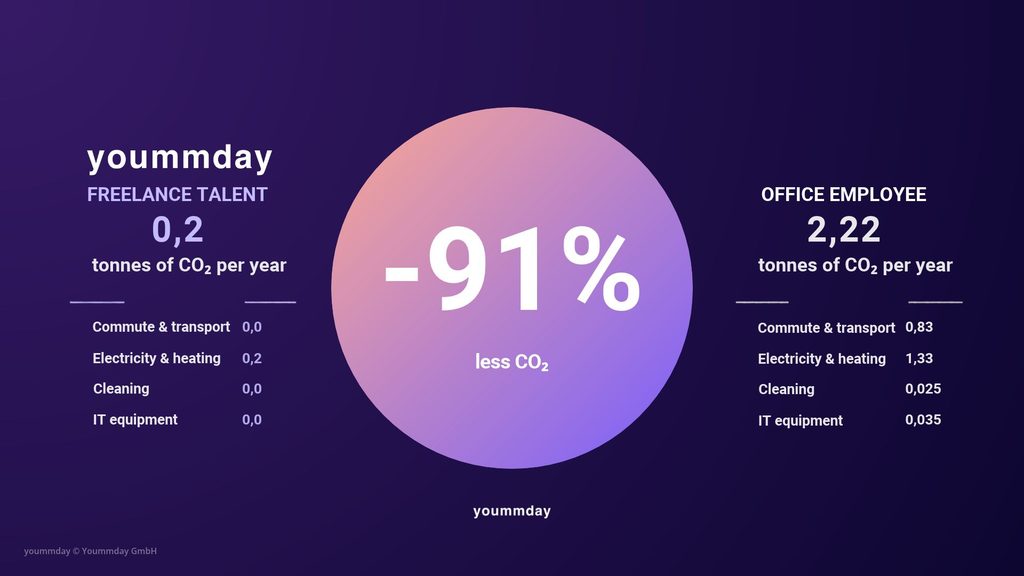
Working in customer service and sales on yoummday’s platform causes around two tons less CO₂ per person per year than working in a traditional office. That equals 91% fewer emissions. This is the result of a calculation by the Munich-based scale-up, drawing on public data from the Federal Statistical Office (Destatis), the German Environment Agency, the German Energy Agency (dena) and the Öko-Institut. yoummday connects more than 30,000 freelance service specialists with proprietary AI and automation solutions and handles customer service and sales for companies. The service specialists work via yoummday’s platform from verified home offices.
Where the difference comes from
According to the calculation, an average office-based employee in Germany accounts for around 2.2 tons of CO₂ per year. The largest item is energy: the calculation assumes 1.33 tons for electricity and heating, based on around 25 square meters per person, including a share of corridors, kitchens and meeting rooms. Working remotely also generates emissions, but significantly fewer: for an average 12-square-meter home office, they amount to around 0.2 tons per year.
The second major item is commuting, at 0.83 tons. With an average one-way distance of 17.2 kilometers, office employees travel around 7,150 kilometers a year, and according to the German Microcensus, 65% of them commute by car. For service specialists on the yoummday platform, this commute is eliminated entirely. Commercial cleaning and the production of additional IT equipment add a further 0.06 tons for office-based work.
For a customer service project with 100 full-time positions at yoummday, this amounts to around 200 tons less CO₂ per year than in an office. This means 100 people working via yoummday’s platform cause only as much CO₂ as nine working in an office. The avoided commutes alone add up to more than 700,000 kilometers, almost a round trip to the moon.
Why this matters for companies
For companies that outsource customer service or sales, their service provider’s emissions often feed into their own carbon footprint (Scope 3). A partner’s working model is therefore not only a question of cost and quality, but also one that affects a company’s own emissions. When tenders ask about a service provider’s carbon footprint, the calculation provides a transparent basis for the answer.
“Customer service has traditionally been delivered from fixed locations. Since 2016, we have been showing that there is another way,” says Pablo Harisch, co-founder and co-CEO of yoummday. “We have now used public data to calculate how much our model reduces the carbon footprint: around two tons of CO₂ per person per year. Companies don’t have to choose between lower emissions and high service quality. The model that saves emissions is the same one that flexibly adapts capacity to demand.”
The platform model makes no compromises on data security either: yoummday is ISO 27001 certified. This international standard defines how a company protects data, from access rights and the handling of security risks to clear procedures for incidents. Independent auditors regularly check compliance with the requirements. An internal operations team is also responsible for quality in day-to-day operations.
Calculation methodology
- Basis: 208 working days per year and German averages. Sources include the 2024 Microcensus (Destatis), emission factors from the German Environment Agency, dena benchmarks for office buildings and the Öko-Institut study on working from home (2022).
- Comparison: A traditional office job with a fixed desk compared with remote work by a freelance service specialist on the yoummday platform.
- IT assumption: The service specialists use their own existing devices. The emissions from manufacturing these devices are therefore not attributed to them.