The Operating Model: Technology Enables People
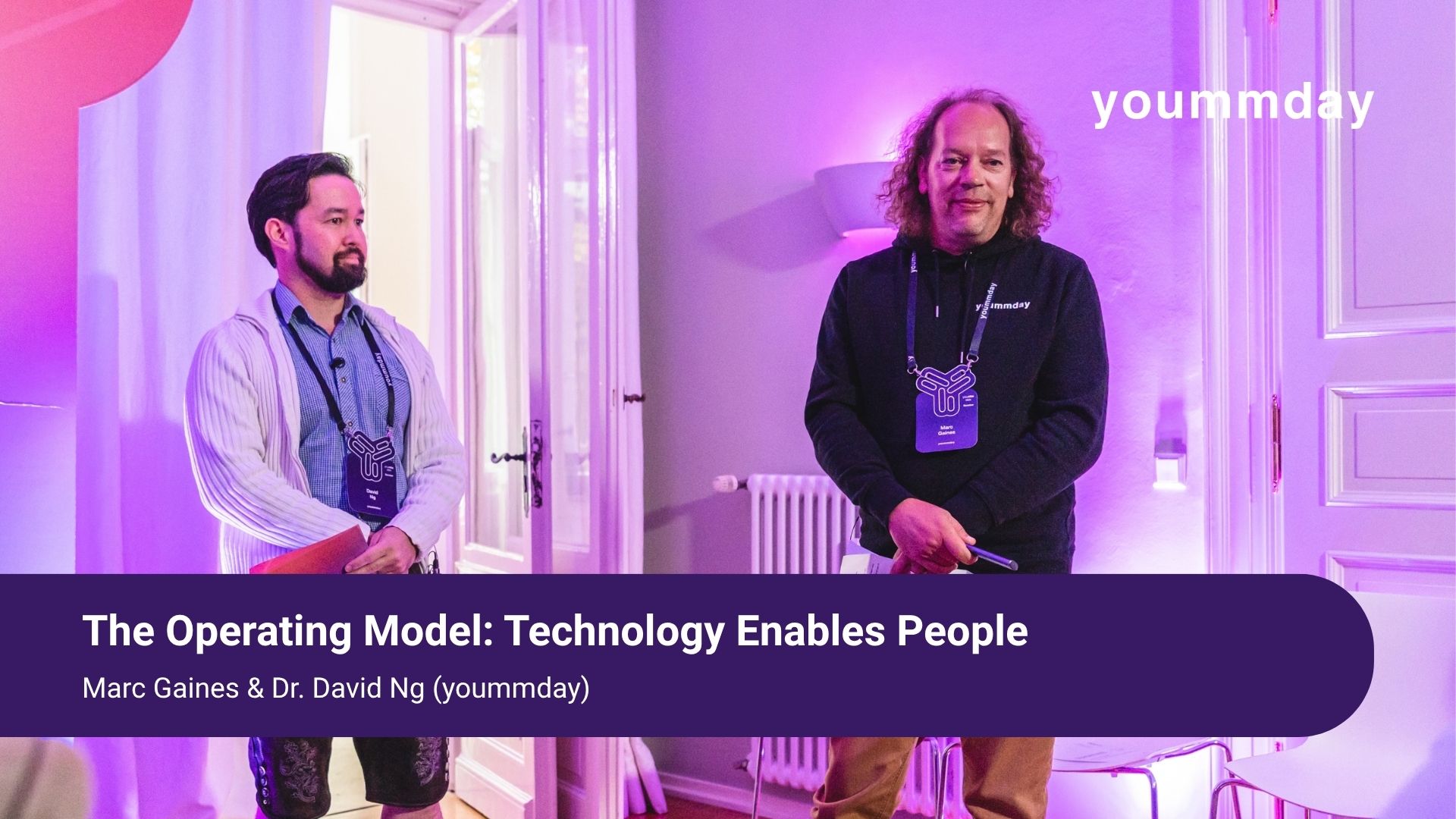
An insight piece based on a presentation by Marc Gaines, SVP Engineering & Technology
and Dr. David Ng, Head of AI Product & Engineering, yoummday
Why this matters for customer service today
The debate about AI and customer service is often framed as a binary: will AI replace human agents, or won’t it? That framing is not just unhelpful – it misses the real engineering challenge entirely.
At yoummday, we believe the question is not whether AI replaces humans in customer service. It is how technology can free human agents from everything that gets in the way of doing their best work – so that when a customer needs a person, that person is fully present, fully equipped and fully focused.
That is the operating model we are building. At our CX event younite 2026, Marc Gaines, SVP Engineering & Technology, and Dr. David Ng, Head of AI Product & Engineering, shared the thinking behind it – and the honest engineering challenges that stand between the vision and reality.
What job shadowing revealed
Marc started with a confession. When he joined yoummday, he arrived with a bias. He had read the news. He knew the narrative: AI would replace customer service agents. So when he insisted on doing job shadowing sessions – sitting alongside agents across multiple customers, work types, voice, text, email and ticketing – he was expecting to see a role that AI could easily take over.
What he saw was more complicated.
“I asked myself: replacing them? They create value. They really create value, these humans. Should we really get rid of them?”
But the observation that stayed with him most was not what the agents were doing in their conversations with customers. It was everything else they were doing at the same time.
Six or seven different systems, open simultaneously. Switching between them in the middle of a call. Documenting everything manually. Learning hundreds – sometimes between 100 and 150 – different workflows, for a single customer and a single work type. Multiply that across the number of customers yoummday serves, and the number of workflows runs into the thousands.
“This is the real complexity,” Marc said. “Not putting a voice bot there. Just… this is crazy.”
The question he came away with was not “how do we replace these people?” It was “how do we free them from all of this, so they can focus on the thing that actually creates value – the human in front of them?”
The hidden layer underneath every interaction
The insight from job shadowing is deceptively simple: the conversation is only the visible part of the work.
Underneath every customer interaction is a process layer: systems to navigate, information to find, actions to document, decisions to log. The customer never sees it. But it consumes a significant portion of every agent’s time and attention during the call.
This is where Marc and David’s engineering thinking begins. If the process layer can be automated – not the conversation, but the work that surrounds and supports it – the agent can be free to do what only a human can do: listen, understand, empathize and resolve.
The goal, as Marc put it, is to give every agent one application instead of seven. The complexity is still there, it’s just hidden from the agent, handled in the background, so they never have to see it
“They just get one application from us,” Marc explained. “This simplifies the training of the freelance talents. They just have to learn this application, and the rest will be configured.”
The engineering challenge: learning what agents actually do
Building that application requires solving a problem that sounds straightforward but is not: understanding, at scale, exactly what agents are doing across thousands of different workflows.
This is where David’s work begins. The approach is not to map processes manually – there are too many, and the variation is too great. Instead, the team is building AI systems that can observe agents at work, understand what they are doing and why, and generalize from those observations to build a model of how the work actually flows.
“We are not building AIs to solve these problems right now,” David explained. “We are building AIs to gather the data to train the next generation of agents.”
The process has four stages: observe, understand, generalize, and execute. Using speech-to-text models to capture sentiment, visual models to understand what agents are doing on screen, and language models to capture intent, the team is building a dataset of agent behavior that no general-purpose AI company could create on its own.
“Companies like OpenAI are always one step ahead because they have to pay for data,” David said. “We don’t have that problem. We have tens of thousands of freelance talents who we can observe. We can watch exactly what they do. We can ask them to annotate it.”
What emerges from observing hundreds of skilled agents across thousands of interactions is not a single workflow. It is a graph – a map of the many different paths through a complex process, with all the variations, shortcuts, corrections and judgements that skilled humans make along the way.
Why current technology is not yet enough – and what is coming
Marc and David were notably honest about the gap between the vision and current reality.
The models that exist today are not yet fast enough for real-time customer service. The best AI systems can produce remarkable answers – but they take time. A customer on hold for two minutes while an AI reasons through a complex problem is not an acceptable experience. Speed is a fundamental constraint.
Training models is expensive and slow. And for customer service specifically, the feedback loop that makes AI training work – a clear signal of whether an answer was right or wrong – does not yet exist. You can verify a mathematical proof. You can run code and check if it works. You cannot easily simulate a realistic customer, run thousands of interactions and score them reliably enough to train on.
“Customer service isn’t quite so nice,” David said. “You need a simulated customer first. Then you have to judge it. Those things just don’t exist right now.”
But the trajectory is clear. The cost of intelligence has fallen dramatically – over 79 times in a matter of months, by David’s estimate. New chip architectures are coming that will increase model speed by orders of magnitude, from tens of tokens per second to thousands. The constraints that exist today will not exist in two to three years.
“We have to plan for what’s going to be happening in a few years,” David said. “We can make little jumps now, and we do already. But the really big changes – they’ll be there at industrial scale probably mid-next year.”
Risk, reliability and keeping the human in the loop
Building AI systems for customer service also means confronting a fundamental tension: AI is not deterministic. It is probabilistic. It makes mistakes. And the reliability standards for customer service are very high.
Marc and David’s approach to this is deliberate and sequential. New AI capabilities are not switched on across all of customer service at once. They are run in parallel with human agents first – shadowing them, producing outputs that are compared against what the agent actually does, and only when the team is confident the results are reliable enough does a specific, narrow task get handed to the AI.
“We hand off that particular task – not all of CX, but that particular task,” David explained. “Into something we can hand off.”
Critically, the human remains in the loop at every step. Any action that has a real-world consequence – a refund approved, a replacement sent, a decision made on behalf of the customer – requires human approval. The AI handles the process. The human makes the call.
“Whatever this application is doing,” Marc said, “there should always be the human involved. If some action has to be done, it’s always a decision – an approval – by a human that is required.”
The agent becomes the teacher
Perhaps the most striking reframe in Marc and David’s talk is what happens to the role of the agent in this model.
Today, agents are the users of systems. They navigate the complexity, switch between applications, and carry the cognitive load of multiple workflows in their heads. In the model Marc and David are building, that changes. Agents become the teachers of the systems – the source of the expertise that the AI learns from.
“The talent will not be the user of the systems like today,” Marc said. “It will become the teacher of the system we will build here. And that’s a different thing.”
This is not a story about AI replacing human expertise. It is a story about capturing and scaling human expertise – so that the knowledge a skilled agent has built over years of handling complex situations can be embedded in a system that makes every agent better.
What this makes possible
Marc closed with a concrete vision of what this operating model enables.
An agent freed from the process layer can handle more cases – potentially ten in parallel, in half the time. But the more important change is qualitative: when the agent is not switching between seven systems, they can focus entirely on the customer. On listening. On empathy. On understanding what the person on the other end of the call actually needs.
“If we automate this,” Marc said, “a talent can deal with ten cases in parallel. And then they can focus on the caller. Really applying empathy, making them heard. Or even doing sales – which brings money, not only for you, also for us.”
The technology is already being built. By the end of the year, Marc and David expect to have a version zero – a working prototype for one work type, with one customer – ready to test in real conditions. Not theory. Not a roadmap. A beginning.
Three key takeaways for CX decision-makers
1. The process layer is where the complexity lives – and where the opportunity is
The conversation between agent and customer is only the visible part of the work. Underneath it is a process layer of systems, workflows and documentation that consumes significant agent time and attention. Automating that layer – not the conversation – is where the real efficiency gains are. And freeing agents from that layer is what makes great customer interactions possible at scale.
2. AI will not replace human judgement in customer service – it will enable it.
The edge cases, the emotional interactions, the situations that require real understanding and real empathy – these are not going away, and they are not what AI is best placed to handle. What AI can do is take the routine, predictable, process-driven work off the agent’s plate, so the human can be fully present for the moments that matter. Design your operating model around that distinction.
3. The human in the loop is not a limitation – it is the design principle.
Every consequential action should require human approval. Not because AI cannot be trusted, but because the value of the human agent is not just in what they do – it is in the judgement, accountability and relationship they bring. Build your AI infrastructure around the human, not alongside them. The goal is not human in the loop. It is human in charge.
About the speakers
Marc Gaines is SVP Engineering & Technology at yoummday, where he leads the engineering organisation and is responsible for the platform that powers yoummday’s CX operations. He joined yoummday with deep experience building and scaling engineering organisations and a conviction that AI and human talent work best when they are designed to complement each other.
Dr. David Ng is Head of AI Product & Engineering at yoummday, where he leads the development of AI capabilities across the platform. With a PhD from the Max Planck Institute and over a decade of experience leading AI-driven innovation at institutions including Munich Re, he focuses on where AI genuinely performs in CX, where it falls short, and how to build systems that make the most of both.
This article draws on a presentation by Marc Gaines and Dr. David Ng at younite 2026, yoummday’s event for CX leaders, held under the theme “ThisGen CX: From Cost to Value.”