The Human Premium: Measuring What Customers Really Value
An insight piece based on research by Prof. Dr. Ophelia Deroy, Chair of Philosophy of Mind & Neuroscience, LMU Munich
Why this matters for customer service today
The business case for AI in customer service is usually built around one question: can AI do the job a human does today? If it can – at lower cost and higher scale – the logic follows that you should automate. But should you really?
At yoummday, we work every day with companies navigating exactly this question. And while the operational case for AI is real, we believe it is incomplete. There is another question that most organisations are not asking – and it changes the calculation significantly.
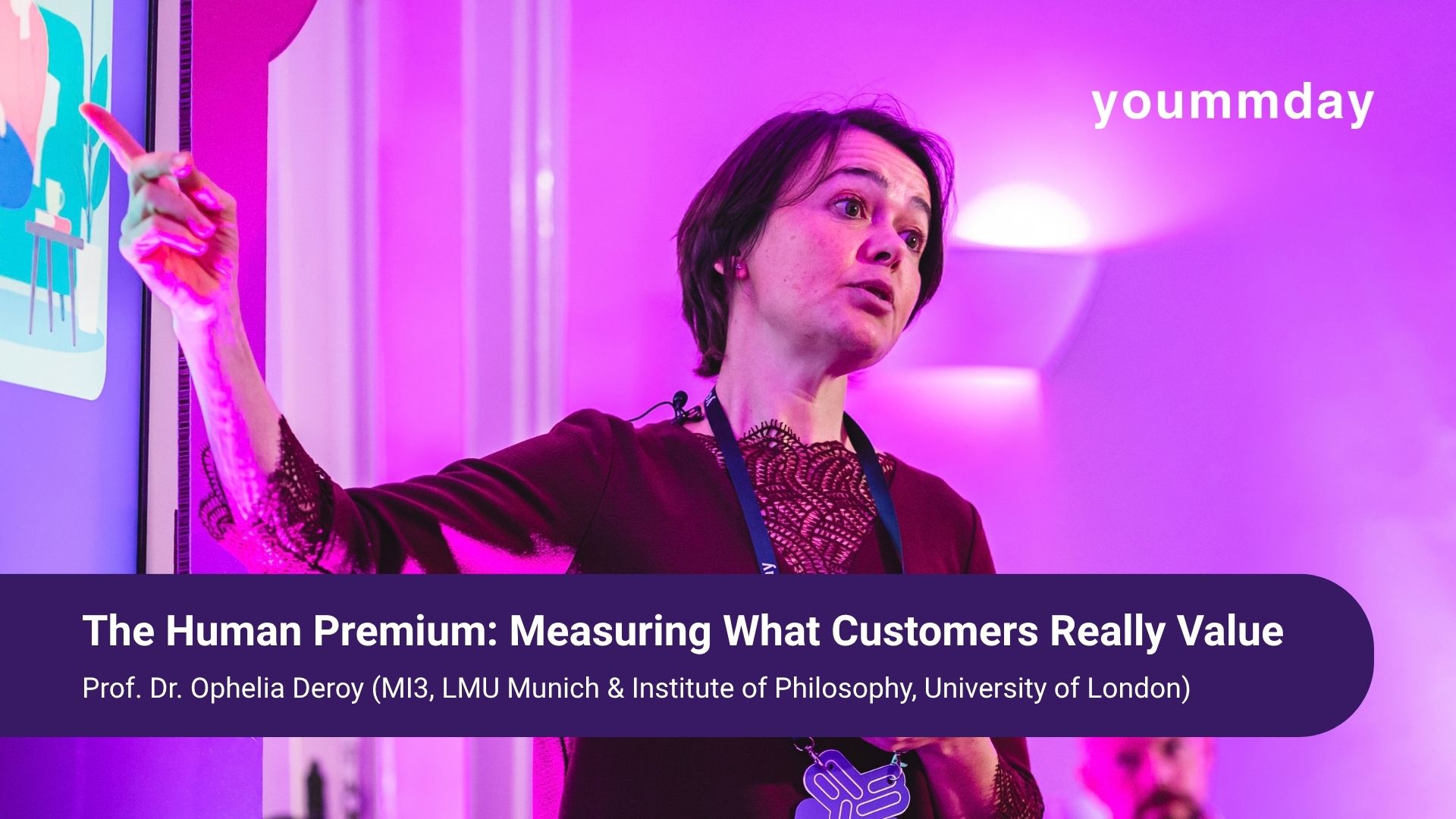
That question is the focus of Prof. Dr. Ophelia Deroy’s research. At our CX event younite 2026, she presented findings that challenge how CX leaders think about AI deployment – not from an operational angle, but from a behavioral science one. Her argument: even when AI performs identically to a human, customers do not always respond the same way. And that difference has direct implications for loyalty and revenue.
The question the industry is asking – and the one it should be asking
Most AI evaluations in customer service focus on performance: can the AI match what a human does? Response time, accuracy, resolution rate. If the numbers are close, the case for automation looks strong.
But Ophelia draws a sharp distinction between two very different questions.
The first: can customers tell whether they are talking to a human or an AI? This is essentially the Turing test applied to customer service – a question of matching performance. Many companies are working hard to close this gap, and in many domains it is already closed or closing fast. Surveys of thousands of AI experts conducted in 2022 and 2023 show that predictions about AI capability are consistently being revised forward. Tasks aligned to customer service, such as telephone banking, chat support, and routine queries, are among them.
The second question is the one Ophelia’s research focuses on: when customers know they are talking to AI – because you have told them, as you are ethically and increasingly legally obliged to do – do they respond the same way? Even when the words are identical?
This is not a hypothetical scenario. In the EU, since August 2026, the AI Act has required companies to disclose when a customer is interacting with an AI system. The performance-matching question and the customer response question are not the same thing. And only the second one tells you whether your AI deployment is actually creating value or missing out on it.
What the research shows
Ophelia and her lab study human responses to AI across four types of interaction: influence, compliance, cooperation and delegation. The findings are consistent and commercially significant.
Influence: does AI advice get followed?
When a human gives advice, people are more likely to follow it than when the same advice comes from an AI. This effect is strongest in personal, emotional and high-stakes domains – mental health, relationships, significant financial decisions. In purely analytical tasks – which flight to book, which policy applies – the gap is smaller and sometimes disappears entirely.
There is an interesting flip side: when AI delivers bad news, people feel less hurt. So there is a genuine trade-off depending on what you are optimising for.
Empathy: rated higher, until people know it’s AI
A large independent study found that when readers did not know the source, they rated AI-generated messages as more empathetic than human-written ones. The reason is simple: AI systems like ChatGPT are trained to be effusive with praise – “That’s a brilliant idea.” Humans are more likely to say “Not bad.”
But the moment the same messages were labelled – “written by a human” or “written by an AI” – the human won. People would rather receive a less empathetic message from a human than a more empathetic one from an AI. The words are the same. The belief changes everything.
Cooperation: less politeness, more cheating
In a study about road behaviour, 60–70% of participants said they would slow down to let another car merge – even when that car did not have priority. When told the other car was self-driving, significantly fewer people slowed down. But they still expected the AI car to be nice to them.
That asymmetry matters for customer service. An AI agent is trained to be cooperative. Customers know this – and some take advantage of it. They are less patient, less polite, and more likely to bend the rules when they know they are dealing with a machine. The social cost of bad behaviour feels lower.
This was also confirmed in tax declaration experiments: when people reported to an AI rather than a human, honesty dropped. The cost of cheating felt less prominent.
Delegation: clean hands, lower standards
One of the strongest findings in Ophelia’s research comes from a large set of experiments published on the front page of Nature. When people delegate a task to an AI rather than a human, they are significantly more willing to make unethical choices. Crucially, they do not ask the AI to cheat directly. They ask it to “maximise their profit” – knowing that cheating is the only way. Their hands stay clean.
This has direct implications for customer service operations. When agents delegate interactions to AI, the ethical guardrails that govern human-to-human interaction may weaken. The risk does not come from the AI – it comes from the human side.
The cultural dimension
WThese findings are not universal. A version of the cooperation study conducted in Japan showed a smaller gap between responses to humans and AI. Japan has a different cultural relationship with technology, and highly rule-driven social norms that limit the expression of preference.
The implication for CX leaders is important: the human premium – the extra value customers place on an interaction simply because a human delivered it – is not fixed. It varies by culture, by context and over time. What holds in a European market may not hold in the same way in Japan, China or the United States. Measuring your own customers’ responses – rather than relying on general findings – is the only way to know where the gap lies in your specific context.
Two readings of the same evidence
he research consistently shows a gap between how customers respond to humans and how they respond to AI – even when the behaviour is identical. But what does that gap mean?
Ophelia identifies two ways of reading it.
The first is the machine penalty view: the gap is a bias, driven by resentment or unfamiliarity with AI. If so, it should be corrected – through education, transparency and exposure. As customers become more comfortable with AI, the penalty fades. Healthcare is a useful example: AI is now highly accurate at reading X-rays, yet many patients still resist having their results interpreted by a machine. The job there is education – helping patients understand that accuracy matters more than who delivers the result.
The second is the human premium view: the gap reflects a legitimate preference, or a rational expectation of higher returns from interacting with a genuine person. If so, it should not be erased – it should be designed around. Pushing AI harder in moments where the human premium is real will not close the gap. It will widen it, and may backfire. Customers may feel patronised or manipulated. Hiding AI from customers who prefer humans does not change their preference – it damages trust.
Neither reading is settled by a single study alone. The answer depends on the specific context – the type of interaction, the relationship, the customer segment and the market. Which is exactly why measuring your own customers’ responses, in your own context, is the only reliable way to know which view applies to you.
Transparency: the short-term gain and the long-term damage
If AI scores better on empathy when customers do not know it is AI – should you keep it quiet?
Measured at the level of a single interaction, it can look tempting. But measuring only the transaction hides the long-term cost. If customers believed they were talking to a human and later find out they were not, the reputational damage is severe – and hard to recover from. A less empathetic interaction is something most customer relationships survive. A betrayal of trust is not.
In the EU, the question is already settled by law. But even where legal requirements leave room, the business case points in the same direction: design for transparency, not around it. The useful questions are how to make AI interactions work well when customers know it is AI – and which moments are better served by a human.
Where the human premium is strongest
The human premium is not evenly distributed across all interactions.
It is strongest where the interaction is personal, emotional or high-trust: an escalated complaint, a payment difficulty, a cancellation that could still be saved, a health-related question. In these moments, a human who performs slightly less efficiently than an AI can still produce a better outcome – because customers respond to them more favourably. They follow the advice, accept the decision, stay honest, cooperate and come back.
For analytical and transactional tasks – finding information, routing a query, explaining a standard policy – AI performs well and customers largely accept it.
The premium is also stronger in premium customer relationships. The more a brand depends on loyalty, emotional connection and repeat business, the more the human element carries weight. A tomato is a tomato. A car, a piece of clothing, a financial product – these are personal. The interaction matters differently.
The useful question is not “human or AI?” It is “in which moments does a human change how the customer responds – and by how much?”
Three key takeaways for CX decision-makers
1. Performance parity is not the finish line
Closing the performance gap between AI and human agents does not automatically close the value gap. Customers who know they are talking to AI may respond differently – less compliant, less cooperative, less loyal – even when the service quality is identical. Measuring customer response, not just task performance, is where the real business case lives.
2. Match the moment to what is at stake
For analytical, informational and high-volume interactions, AI performs well and customers largely accept it. For emotional, personal and high-trust moments – escalations, complaints, payment difficulties, premium relationships – the human premium tends to be strongest. Design your model around that distinction rather than applying a blanket approach.
3. Disclose, measure and adapt
Design for transparency – not around it. Hidden AI risks lasting reputational damage, and in the EU disclosure is now required by law. Then measure the human premium in your own customer base, across your specific markets and interaction types. Customer attitudes vary by culture and will evolve over time. The machine penalty and human premium are not fixed answers – they are hypotheses to test in your own context, and to keep testing as things change.
About the expert
Prof. Dr. Ophelia Deroy is Chair of Philosophy of Mind & Neuroscience at Ludwig Maximilian University (LMU) Munich, where she directs the Munich Interactive Intelligence Initiative (MI3), and holds a research affiliation with the University of London. Her work spans philosophy of mind, cognitive science and artificial intelligence, with a particular focus on how humans interact with and respond to AI systems. She has advised public and private institutions including the European Parliament and the UK Department for Science, Innovation and Technology. Her research has been featured in The New York Times, the BBC, New Scientist, Le Monde and Le Temps.
This article draws on a presentation by Prof. Dr. Ophelia Deroy at younite 2026, yoummday’s event for CX leaders, held under the theme “ThisGen CX: From Cost to Value.”