Giving Orientation, Not a Verdict: What Two Founding Scientists Tell Us About AI in CX
An insight piece based on a presentation by Dr. Klaus Harisch, Co-CEO and Co-Founder, yoummday
Why this matters for customer service today
Every week, another headline tells us that AI will transform customer service. Rarely does anyone stop to ask: where does AI create the most value in CX?
At yoummday, we believe that is the right question to start with. Not whether AI is good or bad, but where it genuinely creates value for customers and for the business, and where a human still does it better. Getting that distinction right is one of the most consequential decisions a CX leader can make today.
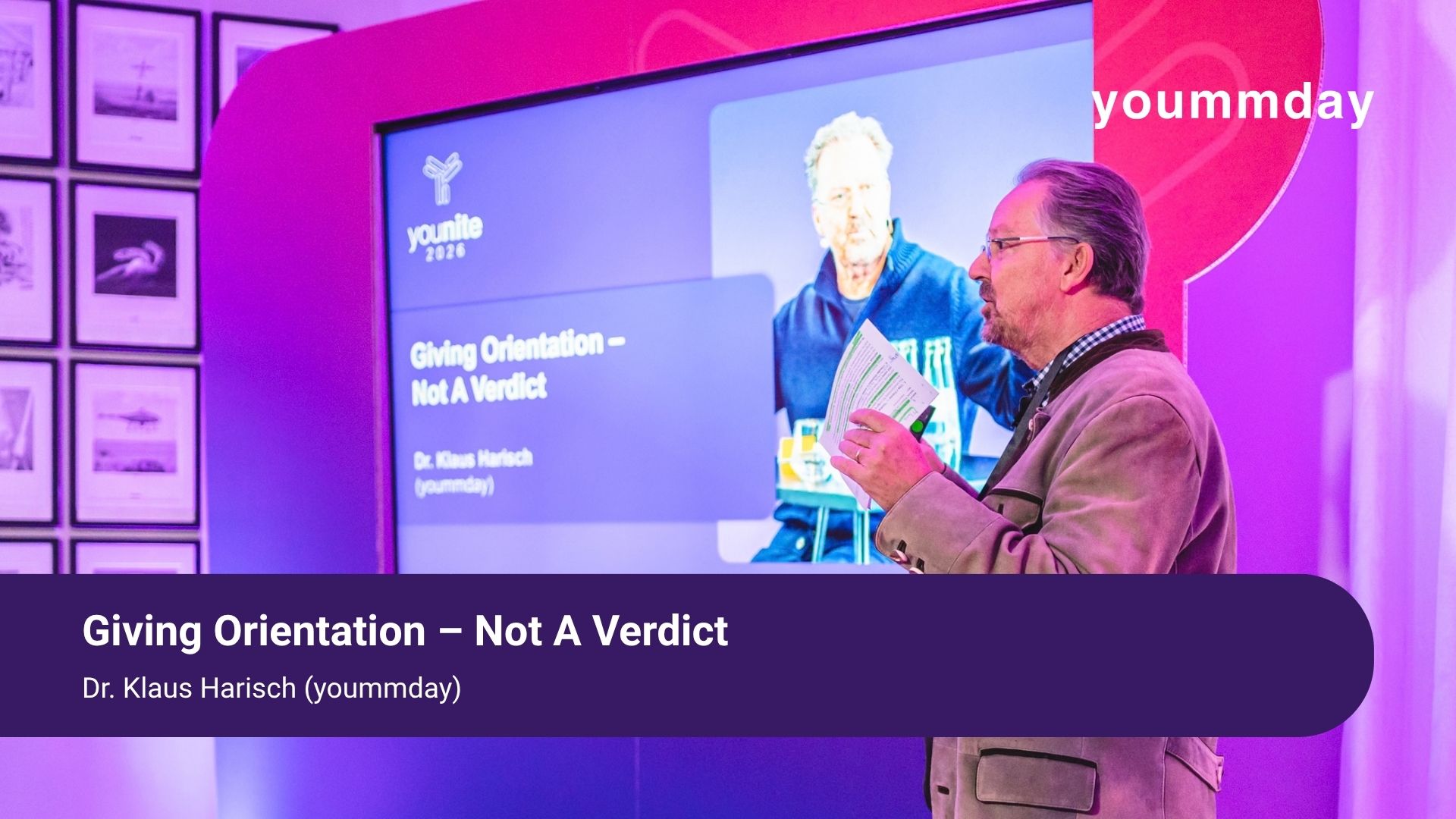
That was the starting point for Dr. Klaus Harisch, Co-CEO and Co-Founder of yoummday, who opened younite 2026 not with a verdict on AI but with something more useful: orientation. His argument was simple. Before deciding where AI belongs in your customer service operation, you need to be clear about what AI actually is – and what it is not. And to do that, you have to go back to the two scientists who shaped the AI conversation.
The problem with the words we use
When people talk about AI today, two words come up more than any others: “information” and “intelligence.” AI processes information. AI is becoming more intelligent. These claims are made constantly, in boardrooms, in strategy documents, in the headlines.
But both of those words carry very precise, very specific definitions – definitions that were established decades ago, by scientists who were solving much narrower problems than the ones we now use their words to describe. And the gap between what those definitions originally meant and how we use them today is, Klaus argued, one of the main sources of confusion about what AI can and cannot do.
Claude Shannon: what “information” actually means
The first scientist Klaus pointed to is Claude Shannon, the mathematician who, as is widely believed, inspired the name of Anthropic’s AI model, Claude. In 1948, Shannon published a paper that founded the field of information theory. His goal was an engineering problem: how do you transmit signals reliably over a noisy channel? Think of a telephone line with interference, or a radio signal with static. Shannon wanted to know how much information could be transmitted accurately, and how.
To solve that problem, he needed a precise, mathematical definition of “information.” And in the very first paragraph of his paper, he made a deliberate and explicit choice: he excluded meaning.
Shannon’s definition of information is about signal – the quantity of data that can be transmitted from one place to another. It has nothing to do with what that signal means to the person receiving it. Shannon was not trying to capture meaning. He was trying to measure transmission. Meaning, he said, was irrelevant to his problem. This was a brilliant and precise engineering decision. But over the following decades, his definition of “information” was borrowed and stretched far beyond the problem it was built to solve. Today, when we say “AI processes information,” most people hear something much richer than what Shannon intended. They hear understanding. Comprehension. Sense-making.
That is not what Shannon’s information is. It is a signal. It does not include meaning by design.
Alan Turing: what “intelligence” actually means
The second scientist is Alan Turing – widely considered the grandfather of artificial intelligence, and the person whose name is attached to the most famous test in the field.
Turing’s original question was: can machines think? It is a profound question – and, as Turing himself recognised, an unanswerable one. In his 1950 paper, he was explicit about this. He could not answer the question of whether machines could think. So he did something mathematically elegant: he replaced it with a question he could answer.
The question he replaced it with was: can a machine imitate a human convincingly enough that a judge cannot tell the difference? That is the Turing test. Not a test of whether machines think. A test of whether machines can imitate.
Turing himself used the word “imitation.” He called it the imitation game. His test was never designed to prove machine intelligence – it was designed to sidestep a question that could not be answered philosophically and replace it with one that could be tested empirically.
But over time, passing the Turing test became shorthand for machine intelligence. The careful, deliberate distinction Turing made between imitation and thinking was lost. And today, when AI systems are described as intelligent, most people are importing a much bigger claim than Turing ever intended.
Klaus put it plainly: if we take Turing’s original framing seriously, we should probably talk about artificial imitation rather than artificial intelligence.
The pattern underneath both definitions
The pattern Klaus identified in both cases is the same.
A scientist creates a careful, narrow, precise definition – for a specific engineering or mathematical purpose. That definition proves useful and gets picked up. Over years and decades, it gets borrowed, stretched and applied to questions far beyond the ones it was built to answer. The original limits are forgotten. And the words end up doing work they were never designed to do.
That is not a problem with Shannon or Turing. It is a problem with how we have used their ideas.
And it matters for CX leaders specifically because the decisions being made about AI deployment – which tasks to automate, which to leave with humans, what to promise customers – are often built on top of claims about AI that rest on these stretched definitions. If the foundation is imprecise, the decisions built on it will be too.
A practical question to ask
Klaus’s recommendation was simple. Whenever you encounter a claim about what AI can do – in a vendor pitch, a strategy document, a news article – ask one question: which definition of “information” or “intelligence” is doing the work here?
Is the claim built on Shannon’s definition (AI processes signals at scale, quickly and cheaply), in which case it is probably accurate? Or is it built on a borrowed, inflated version of those words; AI understands customers, AI thinks – in which case it deserves scrutiny?
That question does not require a technical background to ask. It just requires the habit of checking what words actually mean before accepting what they are being used to claim.
“Machines handle information. Humans handle meaning.
AI takes care of the mechanics. The human takes care of the human.”Dr. Klaus Harisch, Co-CEO, yoummday
Three key takeaways for CX decision-makers
1. Check the definitions before accepting the claims
The most important question to ask about any AI claim in customer service is: what do the words actually mean here? “Information” and “intelligence” carry precise scientific definitions that are much narrower than how they are commonly used. A system that processes information at scale is genuinely valuable. A system that “understands” or “thinks” in a human sense is a much bigger claim – and one worth scrutinizing carefully before building strategy around it.
2. Imitation and intelligence are not the same thing
A system that can pass a Turing test – that can imitate a human convincingly enough in a narrow domain – is genuinely useful. But imitation is not the same as understanding. Designing your CX model around what AI can imitate well, and what it cannot, is more reliable than designing it around claims about what AI is intelligent enough to do.
3. Deploy each where it creates the greatest value
Machines handle signals, patterns and data – at scale, at speed, reliably and cheaply. There is a great deal of customer service work that fits that description: routing, documentation, pattern recognition, summarisation, after-call processing. Humans handle meaning – the understanding of what a frustrated customer actually needs, the judgment that does not fit the pattern, the empathy that makes a difficult interaction feel resolved rather than closed. The goal is not to choose between them. It is to deploy each where it creates the most value – for the customer, and for the business.
About the speaker
Dr. Klaus Harisch is Co-CEO and Co-Founder of yoummday. He co-founded the company around the belief that customer interactions – handled well, by the right combination of human talent and technology – are one of the most underutilised sources of business value in the market today. Under his leadership, yoummday has built a platform that brings together more than 29,000 freelance customer service talents with AI and automation tools designed to augment, not replace, human performance.
This article draws on a presentation by Dr. Klaus Harisch at younite 2026, yoummday’s event for CX leaders, held under the theme “ThisGen CX: From Cost to Value.”