Inbound Call Center · Definition, Operations, Decision
Inbound Call Center: How incoming customer demand is actually managed.
An inbound call center does more than answer the phone.
It combines demand planning, staffing, routing, knowledge, resolution and quality into a manageable service operation. This guide explains how inbound works, which KPIs matter and when in-house, overflow or outsourcing makes sense.

Companies that work with yoummday









24/7
inbound coverage possible
35+
languages
27,000+
vetted Talents
Company-wide delivery capabilities. Actual scope, coverage and mobilisation depend on the individual program.
Quick answer
Inbound means the customer initiates the contact. An inbound call center — or call centre in UK English — is primarily a voice operation for incoming customer needs such as service questions, support, orders, complaints or incidents.
What reaches an inbound team?
From simple enquiries to complex service cases.
The exact scope depends on the operation. Strong inbound teams separate contact reasons clearly and define the expected resolution, permissions and escalation path for each one.
01
Information
Questions about products, contracts, accounts, delivery status or existing cases.
02
Support
First-level or technical issues within the agreed knowledge and permission scope.
03
Transactions
Orders, requests, changes or other clearly defined customer processes.
04
Problems
Complaints, incidents or cases that require prioritised handling or escalation.
05
After-call work
Documentation, ticket updates, follow-up actions or structured handover to the right owner.
The inbound operating logic
A strong inbound call center manages a loop, not just a queue.
Accessibility is created before the call arrives. Forecasting, capacity, routing, resolution and continuous improvement have to work as one operating system.
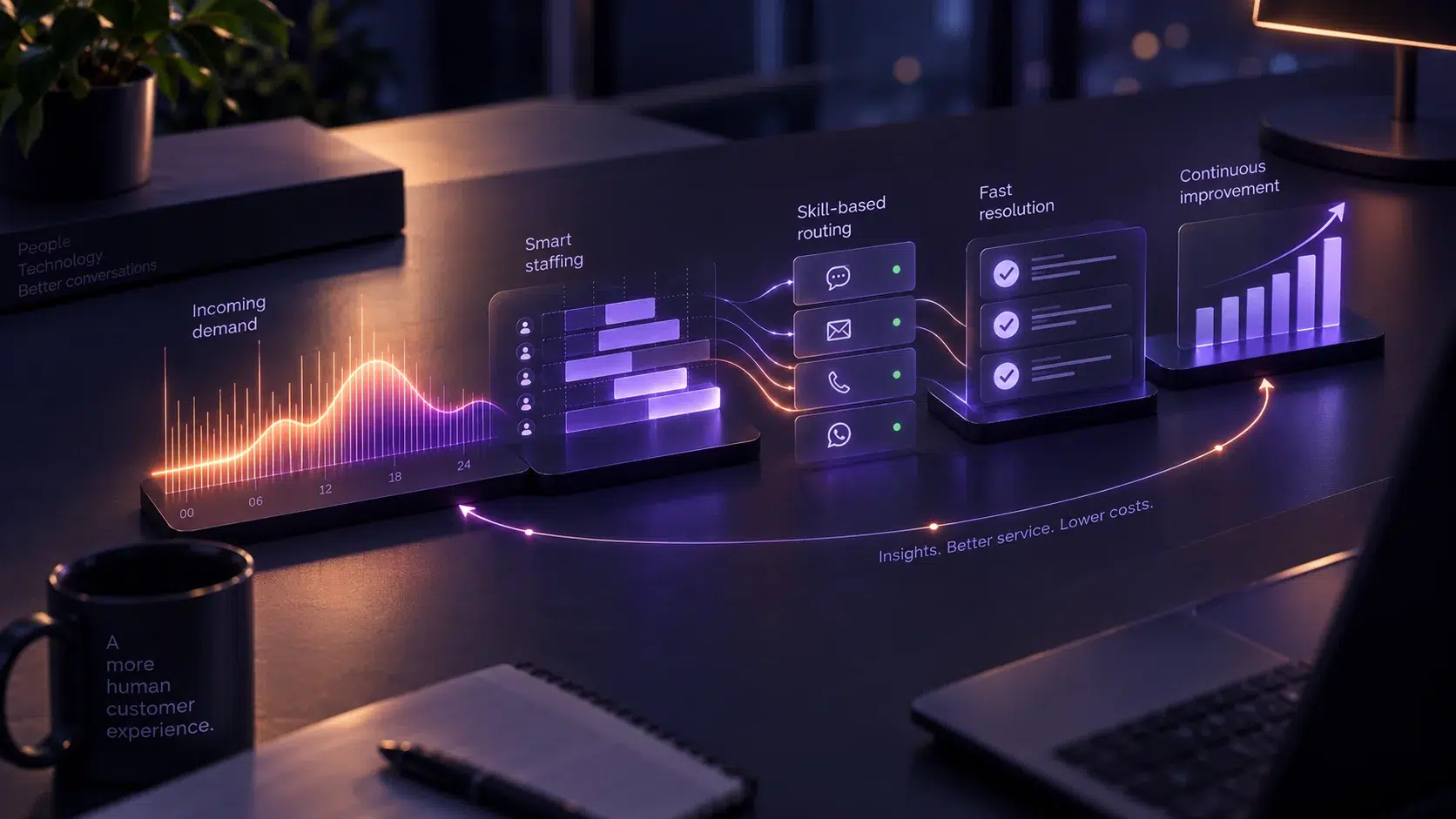
01 · Forecast
When will demand arrive?
Volume patterns, peaks, seasonality and disruption scenarios shape capacity planning.
02 · Staffing
Which skills must be available?
Plan not only headcount, but the right language, product and process capabilities.
03 · Routing
Where should each contact go?
Route by language, topic, priority, product or capability to reduce unnecessary transfers.
04 · Resolution
Resolve or escalate cleanly?
Handle the case inside scope or pass it to the defined owner with the relevant context.
05 · Learning
What improves the next cycle?
Contact reasons, repeat contacts and quality findings feed back into planning, training and knowledge.
Keep the terms distinct
Inbound, outbound and customer service outsourcing are different operating models.
| Inbound call center | Outbound | Customer service outsourcing | |
|---|---|---|---|
| Who initiates? | The customer | The company | Usually the customer |
| Core | Incoming voice contacts | Proactive outreach | A broader service operation across channels |
| Typical goals | Inform, support, resolve | Sell, qualify, book appointments | Run customer-service processes end to end |
| Best next page | This guide | Sales Outsourcing | Customer Service Outsourcing |
Read inbound KPIs together
Five metrics. Five views of service performance.
No single KPI defines a good inbound operation. Accessibility, resolution, effort and quality need to be managed together.
Are we accessible?
What share of demand is answered within the agreed time threshold?
Did we solve the issue?
How many cases are completed without an unnecessary repeat contact or handover?
How much effort does it take?
How long does the interaction plus after-call work take, without optimising speed at the expense of resolution?
Did we meet the standard?
Review interactions against agreed quality criteria, including accuracy, process adherence and communication.
How did the customer feel?
CSAT captures customer feedback on the service received. It complements internal quality assessment.
Why outsource inbound?
What changes when you outsource inbound to yoummday?
A team matched to your customers. Technology that supports every call. An operation built around your needs.

People + support
The right people.
Supported on every call.
Skills matched to your customers
Access the languages and expertise your service needs. Talents are selected for your project, beyond the limits of one local labour market.
Support during the conversation
Knowledge and AI guidance support the agent during the call. The human stays in charge of the customer interaction.
Quality that keeps improving
Training, quality review and feedback help your team deliver consistently and identify where service can improve.

Cost + flexibility
An operation that adapts
to your business.
A leaner cost structure
Remote delivery avoids traditional call-center facility costs. Flexible capacity helps reduce the cost of carrying idle capacity, with performance-based pricing for the agreed scope.
Capacity and coverage around demand
Shape team size, languages and service hours around your customers — for core operations, growth, peaks and extended coverage.
Conceptual illustrations. Team, tools and coverage depend on the agreed service scope.
Choose who runs your inbound operation.
You can choose how much operational responsibility you want to retain.
Managed Service
We run your inbound operation.
yoummday manages the agreed scope end to end. Your business defines its objectives and approvals; yoummday takes responsibility for operational delivery.
- Daily operation
- yoummday
- SLA ownership
- yoummday
Enabled Service
Your managers lead the team.
You retain operational control. yoummday provides the platform and Talent acquisition, with a dedicated Customer Success Manager supporting your team.
- Daily operation
- Your team
- SLA ownership
- Your team
Agree the scope around your needs: core inbound delivery, new languages, additional service hours or overflow alongside your existing team. Scope and management responsibility are separate decisions.

Documented proof
24/7 inbound customer care in a real operation.
A published yoummday program for an international European airline shows multilingual inbound voice customer care under Managed Service, built for fluctuating call volumes. The figures below are project-specific published results, not universal commitments.
Inbound readiness check
Clarify four things before buying capacity.
The clearer the baseline and operating scope, the easier it is to define staffing, responsibilities and target KPIs.
Do you know volume and peak patterns?
Demand by interval, seasonality, planned campaigns and known disruption scenarios form the planning baseline.
Are contact reasons defined?
Which cases should the team resolve, and which need specialist escalation?
Are systems and access clear?
Telephony, CRM or ticketing, knowledge, data access and permissions must match the operating scope.
Do you have baseline and target KPIs?
Without a clear starting point, performance after a transition is difficult to evaluate properly.
The yoummday operating model
Access global talent. Adapt capacity. Launch quickly.
Build your inbound team around the skills you need and the pace of your operation. These company-wide capabilities are scoped to your project.
Global talent access
The skills your service needs.
Talents are based in 70+ countries. Your team is selected for the languages, skills and requirements of your project.
Operational speed
From a prepared start to changing demand.
for standard projects
to go live
team-size adjustment
in 5 hours
Timing and capacity depend on the agreed scope, Talent availability, training and system readiness.
Frequently asked questions
Inbound call center: the key questions from operations and procurement.
What is an inbound call center?
An inbound call center handles contacts initiated by customers. In the narrower sense, it focuses on incoming phone calls for customer service, incidents, orders, complaints or first-level support.
What does inbound telephony mean?
Inbound telephony means incoming calls. In a service operation, that includes more than answering the line: routing, handling, documentation and escalation all sit around the interaction.
What is the difference between inbound and outbound?
In inbound, the customer initiates the contact. In outbound, the company or delivery team initiates the conversation for sales, appointment setting, follow-up or surveys.
What services does an inbound call center handle?
Typical services include general enquiries, first-level and technical support, order intake, complaint handling, incident intake and defined after-call work. Each program should explicitly define which cases are in scope.
Which KPIs matter in inbound?
Core perspectives are accessibility or service level, First Contact Resolution, Average Handling Time, quality and customer-satisfaction metrics. They should be read together rather than optimised in isolation.
When does inbound call center outsourcing make sense?
Not only when demand fluctuates. Outsourcing can also improve steady-state operations by reducing structural cost, widening access to skills and languages, enabling 24/7 or geographically distributed coverage and making quality more systematic. The degree of operational responsibility depends on the Managed, Enabled or hybrid model you choose.
What does overflow mean in inbound?
With overflow, the internal team remains the core operation while an external partner handles predefined additional demand, such as peaks, off-hours or contacts above a threshold.
Can an outsourced inbound call center operate 24/7?
Yes. yoummday documents a 24/7 inbound voice operation for an international European airline. Whether 24/7 is right for a new program depends on demand, languages, systems, training and governance.
How quickly can an outsourced inbound team go live?
Standard projects with yoummday can go live in up to 14 days. Actual mobilisation depends on scope, team size, languages, training, system access, integrations and approvals.
How does AI support an inbound call center?
At yoummday, humans remain in charge of customer interactions. AI supports people and operations through planning, live guidance, transcription and quality analysis rather than replacing the human interaction.
What does inbound call center outsourcing cost?
Cost depends on the specific scope, including volume, complexity, languages, service hours, training, technology and operating model. Actual pricing is quoted per program.
Ready to move from understanding inbound to running it reliably?
Discuss your inbound scope.
Tell us about your contact volumes, languages and service goals. Together, we can define the team, technology and management model for your inbound operation — from a complete service to a clearly scoped part of it.
Volumes & peaks
Service hours & languages
Contact reasons & target KPIs